 by
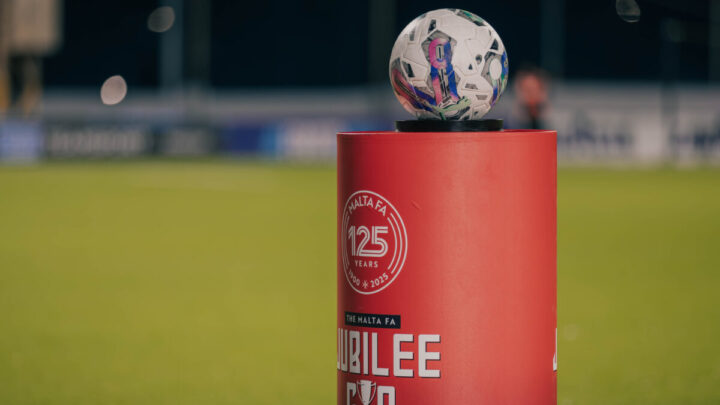
by The Malta Football Association has issued a change in the regulations governing the 125th Jubilee Cup, which will send all matches to penalties if drawn at the ninety, as opposed to extra-time and penalties in the semi-final and final matches. The change affects both women’s & men’s competitions, with the quick turnaround pointing toward buckling under pressures of the men’s game, while pleads for change over a rule massacring the women’s game continue to go unanswered.
Rule Change
The Malta Football Association quietly published a change in the rules governing the Jubilee Cup on Thursday, mid-way through the competition, while committing another glaring oversight of the women’s game.
The competition, marketed as a cup in which the Association is treating equally the women’s and men’s game, featured a rule which previously sent matches to penalties up to the quarter-final, while the semi-final and the final would go to extra-time and penalties.
Fast-forward one week, and as murmurs of its equal impact on the men’s game dawned as quarter-finals and semi-finals approach for the men’s competition, the MFA has published a change in the rules governing the competition. As listed below, all matches will now go straight to penalties after the full-ninety if the match is drawn.
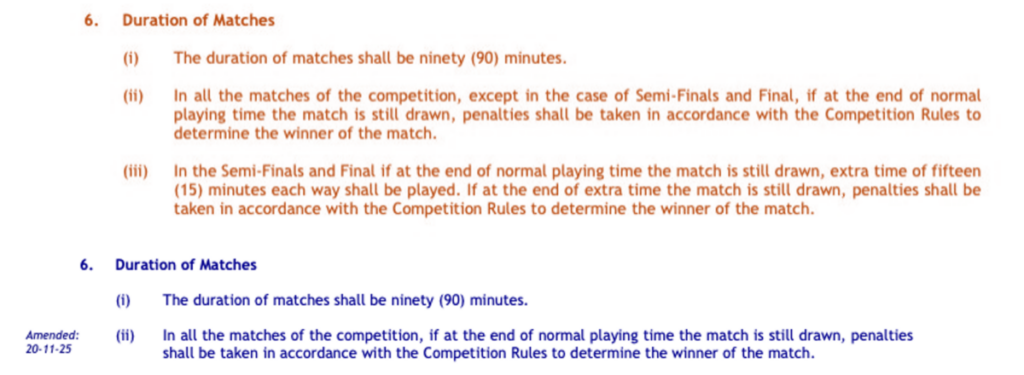
The men’s competition is still getting to the quarter-finals (as from the 29th November), lagging behind due to the sheer number of clubs in the men’s side (52 standard clubs, besides other teams featuring due to the Association’s various arms), as opposed to the 6 teams in the women’s game. The latter, a number continuously touted as the perfect number for the Maltese islands, with the statistical and objective data supporting the statement continuing to remain unforthcoming.
In all intents of equality prevailing from the MFA, the rule change will also affect the women’s final, since unfortunately although on paper it is written to affect the women’s semi-finals, these were already played last week, in the complete lack of any presence of the MFA’s Vice Presidents and President. These were all accompanying the men’s national team for the World Cup qualifying fixture against Finland, which saw the team earn the first win on away soil since 2013, following a hop off in Italy to meet the Pope.
The first semi-final in the women’s competition didn’t even afford the presence of a fourth official, which was hastily assembled for the second semi-final, while The Sporting Fan understands that questions surrounding the rules of the MFA’s own commemorative competition appeared unclear to even the officials minutes before the start of the game.
How Is This Relevant To The 135-Minute Rule?
All this commotion over a rule about extra-time? Well, you’d be hard-pressed to find a coach in the women’s game who isn’t fuming following this change. You’d be hard-pressed to find a youth player dedicated to training and trying to find a way into senior football not wanting to quit. You’ll find a few individuals truly caring about the growth of the game, to be absolutely disgusted by the sheer oblivion that the Association’s highest officials continue to thrive on when it comes to the women’s game, only to surface for a photo when the agenda fits the bill with UEFA & FIFA brass.
Why? This page is littered with comments from coaches who on weeks on end have underlined the continuous impairment that a hastily-scribbled, completely misinformed, 135-minute rule constraining playing time has had on the women’s game.
The Sporting Fan understands that complaints have been repeatedly sounded on its impacts with relevant personnel within the MFA. However, the response received thus far has been unequivocally that rules cannot change mid-way throughout the season, with the decision postponed continuously as players continue to drop, with the game losing promising prospects.
The Jubilee Cup rule-change completely proves that the statement is null. Though in truth, the statement was always null, over the changes that happened last season over the format of the Assikura Women’s Youth League, despite contrary claims.
The rule on Page 22 of the Competition Rules, Section 4i, limits players who alternate between the Assikura Women’s Youth League and the Assikura Women’s League to 135 minutes, between consecutive games. So, a player playing 90 minutes in a Youth League match, may only play 45 minutes in the Senior League next match. They would then be able to play 90 minutes in the following Youth League match.
While it was initiated as a ‘player well-being’ rule, the glaring oversight is the lack of consideration of hours between matches. To give one example, Valletta and San Gwann were constrained by the rule during Tuesday’s Youth League exploits, even though their senior team hadn’t played a game in more than a week.
Even more confusing is the fact that the rule limits on normal playing time. In this regard, it would be perfectly fine for a player to exceed it if they have to play extra-time in a cup competition. It is unclear what medical research was used to back that decision.
In the meantime, the MFA also came into hot-water with the Youth National Teams of the U17 and U19 scheduled to play two friendlies at the end of October, both of which were fixed within 48 hours. Questioned about the 135-minute rule were fielded to the national team coaches, with them having to side-step around an answer, despite some having nothing to do with the rule.
It remains to be seen what stick will be used to define the next step.
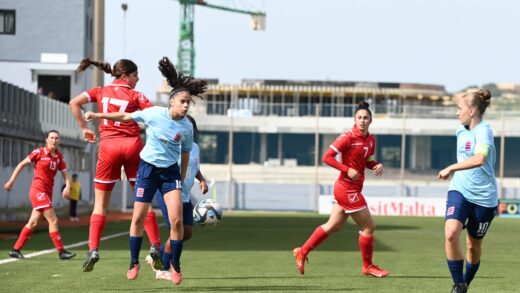
Lead Image: Maraya Gauci
Stay up to date by following The Sporting Fan on social media: Instagram ~ Facebook ~ X

2 Responses
[…] then, the final awaits. The match will go straight to penalties if the ninety minutes is not enough to separate them. The two called on their own supporters to make their voices heard and presence known, with a wider […]
[…] Inconsistency Thrives As MFA Changes Jubilee Cup Rules Mid-Way While Continuing To Ignore The 135-Mi… […]