 by
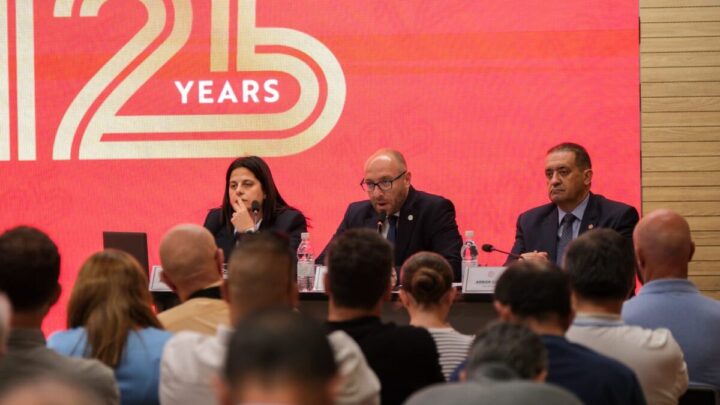
by The Malta Football Association launched its second Strategy last week, Forward Together. President Bjorn Vassallo underscored the desire for the Strategy to be a shared vision for stakeholders. The document addresses the key areas that the MFA will be prioritising, giving some insight into objectives, what it will monitor and what it will not.
What Is Its Purpose & Why Does It Matter?
The Malta Football Assocation (MFA) set out a new Strategy for the period 2025 to 2028 named ‘Forward Together’. It seeks to build on the Strategy set between 2020 and 2024 ‘We Can Perform Better’.
The vision is that ‘Football is a source of pride, joy and inspiration for the whole nation.’
President Bjorn Vassallo echoed this in his address of the Strategy, “This is not just a document for the Association records, it will serve as a shared vision for everyone who loves and enjoys the game. Whether a football player chasing your dream, a coach developing talent, a referee upholding the spirit of fair play, a supporter cheering from the stands, or a club official working behind the scenes… your role matters. With coordinated collaboration and dedicated effort, together we can continue building on the recent accomplishments to turn this vision into execution.”
Targeted for the period between 2025-28, the MFA has defined that the mission will be “To develop the game of football and everyone involved in it, bringing people together through a positive sporting culture.”
The focus will be “on raising the quality and standards of football experiences and environments in Malta. This quality over quantity approach is ambitious yet attainable and takes into account the unique context and limited resources of our nation and organisation.”
Why Does It Matter? As addressed by Bjorn Vassallo, strategies are meant to unify stakeholders toward common goals, while also acting as a guide for those involved to assess progress, call out those veering off course and find ways to redirect toward achieving those common goals.
The Five Pillars
The Strategy defines five Pillars, Development on the Pitch, Development Off The Pitch, Commercial Value, ‘Governance, Education & Social Impact’ and ‘Showcasing The Game’. Under each pillar is an overarching goal and the focus areas for each pillar. The Strategy defines areas where Progress will be Monitored.
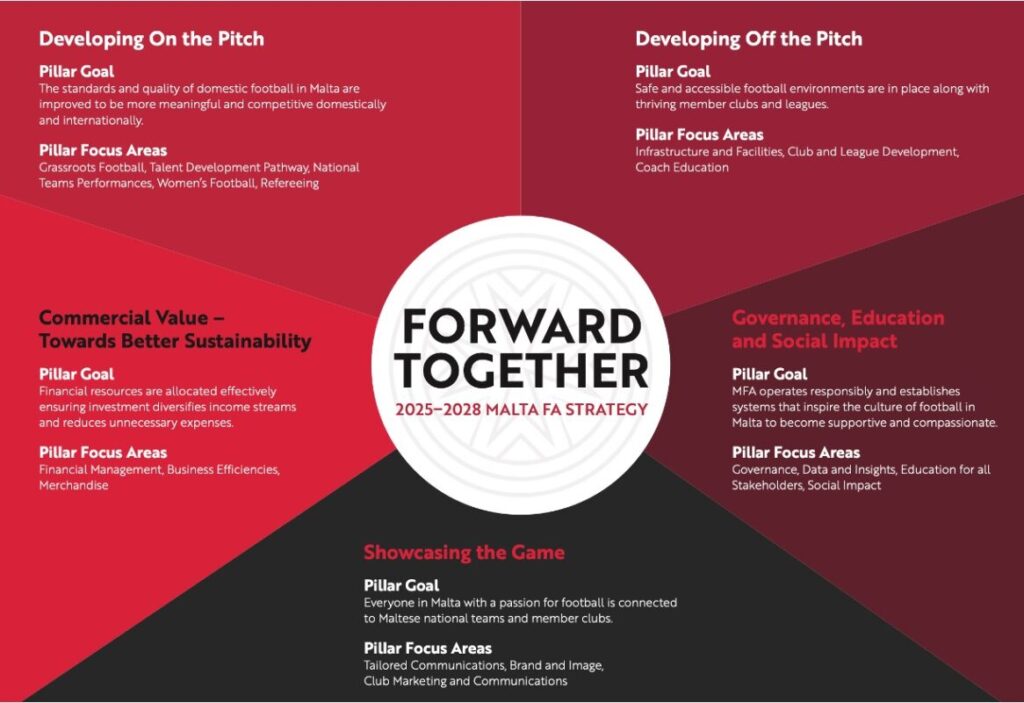
1. Development On The Pitch
Among the key areas are the introduction of a set of ‘ambitious criteria’ for football nurseries, schools and clubs to raise standards for grassroots. It also defines the objective of a Talent Development Pathway, to build on the Technical Programme launched in 2020.
Referees get particular focus with the target to install FVS technology and increase the number of officials. The MFA Strategy hailed the number of domestic match officials on the FIFA list, which remains a target to be grown.
The National Teams are given their focus, a promotion to League C remains the target for the men’s national team as in the previous Strategy, while the women’s target will be to remain in League B.
Women’s Football also gets a separate focus as an area. While the monitoring is on the participation, retention, results and player welfare, the main objective under that section will be to define a women’s football strategy. This has been promised since before the election held in 2024. It is unclear why Women’s Football gets a focus on player welfare and what exactly this entails, and why there is no equivalent for the men’s football category, which isn’t a focus area listed though focused on in several areas of the strategy.
2. Development Off The Pitch
The second pillar focuses on improvement in Infrastructure & Facilities, with a focus on the new training centre and research into improving pitch utilisation due to the increased demand on the limited pitches in Malta.
Coaching education will get a focus to increase the courses and level provided to meet the demand, while the idea will be to increase monitoring and evaluation on licensed coaches.
The focus area of ‘Club & League Development’ focuses strictly on club professionalisation. The MFA strategy recognises that “many clubs in the lower divisions are struggling with administrative, legal, and operational tasks due to a lack of skills, capacity, and resources. To address this issue, we will implement support and insurance programmes to ensure league and club sustainability as well as strong visibility in Malta.” The main objective is to increase professionality in clubs and reduce player compensation arbitration cases.
The ‘Club & League Development’ also states that for women’s football, the specifically-tailored club licensing requirements will be put in place. Additionally, from an overarching perspective there will be new legislation on corporate restructuring for clubs with the biggest outlays.
3. Showcasing The Game
This pillar focuses on improving communication to the general public and harnessing the interest that football enjoys on the islands toward Maltese football.
It defines that the target segment is to be identified, and the Progress Monitoring will be on ‘good reach-out and engagement on social media content’. However, the Strategy does not mention of whether there is a target to increase attendance into pitches and if so by how much, to improve the visibility of matches through live-streaming/broadcasting, or any other metric.
The pillar will also focus on strengthen the MFA’s Brand Image and this will be monitored by annual impact reports. Finally, there will also be focus on aiding clubs to improve their own marketing and communications via sharing best practices and case studies of effective marketing & communication initiatives across European football.
4. Commercial Value – Towards Better Sustainability
The lack of sustainability of football in Malta rightly gets a dedicated pillar. The first focus will be to “protect and enhance revenue streams while adhering to short and long term resource allocation and budgeting.” The progress monitored will be the assessment of revenue and expenditure.
The MFA will also strive to minimise total expenses and it will do this via a business efficiency assessment, addressing its resource efficiency (staff) and processes. Merchandise is singled out as a separate focus area, one that can improve the revenue for the MFA with a focus on making the Malta National Kit a prominent feature in international football fashion culture.
5. Governance, Education & Social Impact
The Governance aspect was an area identified needing focus following the previous Strategy with a target set to finalise the ‘Governance Reform’. It details the setting up of a legal support service for MFA members, and a partnership with a legal firm specialising in sports law. The target is to aid clubs complete corporate restructuring and to have access to legal services.
Education efforts are solely targeted toward two areas. The first is improving respect toward officials. Rather than fining stakeholders, the MFA is seeking to ramp up ‘Respect’ campaigns, while revising its disciplinary reporting. The second area of focus will be to educate the staff within the MFA.
The Strategy recognises that the MFA and its members are not effectively using data and insights available by FIFA & UEFA. The target will be to improve data collection, analysis and management processes. The progress monitored will be that a ‘strategy reporting software is fully functional’, presumably with all data collected, analysed and available for accurate reporting.
From a Social Impact perspective, the Strategy recognises football’s impact on tackling inequality, inclusion and good health. It aims to publish a revised football social responsibility and sustainability document, and carrying out social return-on-investment assessments. The progress to be monitored is that ‘a significant amount of social value is created’.
Opinion: Key Areas Addressed But No Measurable Goals
The Strategy indicates a vision and spreads its arms over the various facets of football. It does try to focus on key areas which have been problematic for the game, such as sustainability. For several focus areas, it does detail the definition of a framework or a legal document, which gives some tangible deliverable of a goal to be achieved.
However, on far wider issues the progress will be difficult to assess and steer. Overall it sets no quantifiable goals for the focus areas. The most or seemingly the only measurable aspect is for the National Teams to reach a particular League status.
To give some examples, while player participation and retention are targets, there are no measurable parameters of what percentage of participation increase and retention would be deemed satisfactory. When it comes to improving the visibility of the game, there are no concrete goals set and no measure of what is deemed to be a goal achieved. The same may be said for a Governance Reform that has no method measuring its success.
On the contrary, most strategies are defined by measurable goals that can hold all involved accountable. The lack of such goals make it difficult to assess the actual ambition in the Strategy for the game in Malta, and will also make it difficult to understand the percentages of the Strategy being fulfilled.
On the whole, the publication of the Strategy gives a vision, which rightly so is intended to harness all stakeholders’ attention toward a concrete set of areas for improvement. It does this well. Even if not all areas deemed important are addressed, the latter can be forgiven considering there is always a time and capacity constraint. However, one hopes that the coming months will give indicators of what the leader deems to be ‘good progress’ or a failure to be addressed. That vulnerable objectivity would truly yield a black on white picture of how far the game is desired to go in each focus area in these years.
The full strategy may be read here. The clip below highlights the key points.
Lead Image: Malta FA
Stay up to date by following The Sporting Fan on social media: Instagram ~ Facebook ~ X



1 Response
[…] On the other hand, some problems being tackled are of a much wider nature, such as structures determining the organization of the league in its financial aspect and club-licensing structures. As noted above, while the two topics have been discussed, the ultimate decision lies with the MFA Women’s Department and the wider MFA. However, the two acknowledged the active requests by the MFA Women’s Department for feedback from clubs in view of the club-licensing structures. This latter initiative is one of the focus areas of the MFA Strategy launched in the past weeks. […]