 by
by Swieqi ZSP secured the U16 double with a 4–0 win over Valletta, though the margin told only part of the story. “We weren’t at our best in the first half,” admitted coach Jeremy Busuttil, as Valletta created early chances before a set-piece opener shifted the game. The decisive moment came after the break — “we knew the second goal would mean a lot” — as Swieqi’s game intelligence turned control into goals. Yet beyond the result, the emphasis remained on development, unity, and what comes next for a group “that managed to join as one.”
Double Secured, But Not Without Its Questions
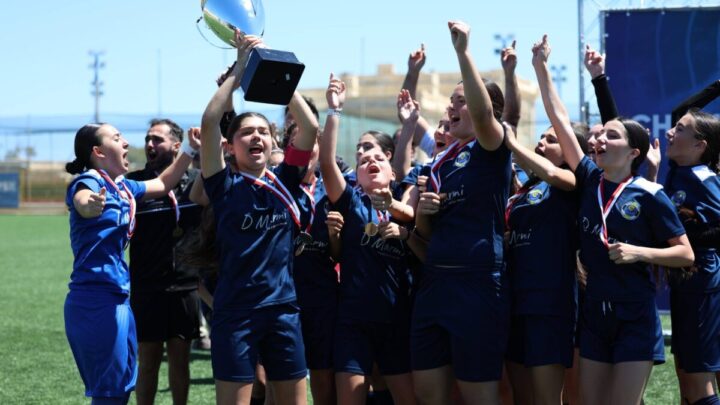
Swieqi ZSP completed the U16 double with a 4–0 win over Valletta in the Knockout final — a result that, on the surface, suggested control. Yet, as Jeremy Busuttil was quick to acknowledge, the reality was less straightforward.
“I think we weren’t at our best in the first half, especially before scoring the first goal,” he reflected. “We scored through a set piece and the conditions were quite challenging as well to deal with given the heat.”
It was a telling admission. For all the eventual margin, this was a final that asked questions before it delivered answers.
Not At Their Best — But Ahead
The early phases belonged as much to Valletta as they did to Swieqi. Shanaia Mifsud dragged a clear opportunity wide of the far post, before Lisa Cauchi forced a sharp intervention from Katelyn Camilleri following a low corner delivery.
Valletta found rhythm through set-plays and second balls, sustaining spells without converting them. Swieqi, meanwhile, showed glimpses — a wide release from Camilleri into Martina Montebello hinted at intent — but not sustained control.
The breakthrough arrived not from pressure, but from execution: a direct free kick that tilted the scoreline without fully shifting the balance of the contest.
In that moment lay the first distinction. Swieqi did not need to dominate to lead.
The Goal That Changed The Final
If the opener disrupted, the second goal decided.
“We knew it would mean a lot for the match, whichever way it went,” Busuttil explained. “I was happy that once we got that goal, our players displayed the game intelligence to read moments to find the third goal.”
On the 65th minute, Katrine Jorgensen drove low into the bottom corner. Within minutes, Rowena Zammit Pace added a curling third, beyond the reach of the Valletta goalkeeper despite a touch.
The sequence was decisive not simply because of the goals themselves, but because of what they represented. The match, still open at 1–0, closed quickly.
Yet Valletta’s resistance did not disappear. Cauchi again went close, while another effort struck the post from inside the box — moments that reinforced a quieter truth: the difference lay less in creation than in conversion.
Swieqi recognised the moment. Valletta could not quite seize theirs.
Development Meets Occasion
At U16 level, such moments are not incidental — they are the point.
“When we spoke after winning the league I mentioned the importance of our players playing in bigger pitches on bigger occasions,” Busuttil noted. “Today was that realised… a final brings pressure even for us coaches, let alone our players who are so young.”
The setting reinforced that idea. A return to Luxol brought with it not just a venue, but a sense of continuity — a ground more familiar to earlier generations of the women’s game than to the players themselves. In that sense, the occasion extended beyond the match, linking a new cohort to a longer effort within the local game, one shaped by those who had pushed for visibility in more constrained conditions.
It was carried by the atmosphere – two sets of supporters, amplified by competing bands, filling the ground with a noise more often absent in the women’s game.
Within that environment, decisions carried weight. Camilleri’s early save preserved parity; her willingness to initiate play from deep hinted at a broader developmental framework, one that extends beyond reactive goalkeeping.
Exposure shaped the experience.
“They need to be exposed, make mistakes and learn from them,” Busuttil added, returning to the theme of the pitch itself in being larger, more demanding and less forgiving.
Built Through Each Other
The double, in that sense, becomes less an endpoint than a reflection of process. Formed through the coming together of Swieqi United and Zabbar St. Patrick’s at this level, the group has spent the season navigating not only opponents, but itself.
“Our focus was development,” Busuttil reiterated. “Some of our players really improved when they played with others quality players. They pushed each other, and we also saw big jumps in players who were new.”
That internal competition — around thirty players learning to function as one — underpinned both league consistency and cup resilience. The final, where they were not at their best yet still found solutions, offered a condensed version of that journey.
The Edge Of Competition
There were, however, moments that hinted at the more complex layers of youth football.
Following the second and third goals, celebrations from Swieqi ZSP players toward the Valletta contingent — where familiar faces and former coaches stood — drew attention. They spoke to the intertwined pathways that define the local game, where movement between clubs is common and histories overlap.
Such reactions can be read in multiple ways. On one hand, they reflect competitive edge — the desire not just to win, but to assert. On the other, they raise questions around restraint and respect, particularly in a developmental setting where behaviour is as much a learned trait as technique.
The line between the two is rarely fixed. In this case, it remained open to interpretation.
Beyond The Double
By the closing stages, the contest had stretched. Ylenia Lovegrove added a fourth late on, marking her return from injury with a goal that Busuttil framed simply: “a player went into the last five minutes, gave everything and was rewarded.”
It was a moment that captured the broader arc — effort, patience, and eventual return. Across the season, those qualities have underpinned both league and knockout success.
Valletta’s experience of the same match was more instructive than the scoreline suggests. They created enough to shape the contest — early opportunities for Shanaia Mifsud and Lisa Cauchi, alongside a second-half effort off the post — but lacked the precision that Swieqi found at key intervals.
In isolation, it is a final lost. In context, it may prove more significant. With questions persisting around the continuity of the club’s women’s setup, this was their final opportunity to translate performance into tangible reward this season.
Yet as attention shifted beyond the final whistle, the question of continuity extended to both sides.
“Good question,” Busuttil smiled, when asked about the future. “They managed to join as one group and that is not an easy feat… I hope that they stay together and that they continue learning from each other.”
For now, the double stands. For Valletta, the absence of silverware leaves a different kind of marker. What follows, for both, may depend less on what this match delivered — and more on what can be sustained from it.
Lead Image: Malta FA
Stay up to date by following The Sporting Fan on social media: Instagram ~ Facebook ~ X