 by
by After Malta’s League B campaign ended without a point, Manuela Tesse and Emma Lipman pointed beyond the final score. Physicality, professionalism, tactical balance and managed youth integration now sit at the centre of the question Malta must answer before the next attempt to make League B hold.
A Slower Match That Still Did Not Turn
Malta’s UEFA Women’s European Qualifiers League B campaign ended without a point after the 3-0 defeat to Türkiye, but the post-match reflections from Manuela Tesse and Emma Lipman pointed beyond the final score.
The result closed the group in familiar fashion. Türkiye, who had opened the campaign with a 3-0 win over Malta, repeated the scoreline at the Centenary Stadium and ended the group in second place. Malta, meanwhile, returned to the same conclusion as their previous League B appearance: relegation to League C, and this time without managing to place a point on the table.
Yet the comments after the match gave the more useful frame. Malta have already shown that they can return to League B. The harder question is whether the team can develop the physical level, tactical balance and professional habits required to remain there.
If there was one condition that might have appeared helpful for Malta against Türkiye, it was the tempo.
The match did not carry the same speed or repeated waves that marked the defeat to Switzerland in Lugano. The rhythm was slower, the passages were less frantic, and Türkiye did not press with constant aggression.
Tesse pointed to the heat and to the energy Malta had already spent in Switzerland, while also suggesting that Türkiye were managing the conditions themselves.
“The pace was dictated by the weather and also the fact that we expended a lot of energy against Switzerland,” Tesse said. “I think it was also an effect on Turkey because they pressed us on the second balls but otherwise let us play, so I suspect they also felt the heat and were managing energy.”
Lipman described Malta’s approach as one based around compactness, with the aim of creating when the opportunity arrived.
“I think we focused on staying compact and trying to keep a middle block in the past two matches, with the aim of creating when we get the opportunity,” Lipman said. “I don’t think we created much today but you also need to consider we had big absences in Haley and even Lexine being out. We had other players coming in who are doing different jobs. I would say we didn’t threaten them probably as much as we wanted to.”
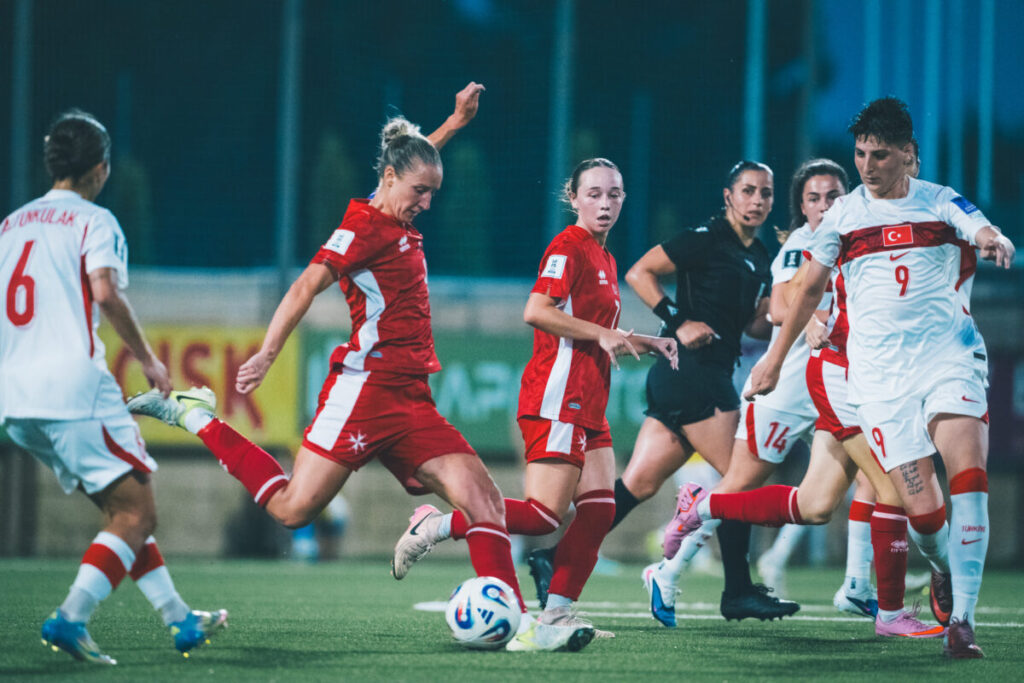
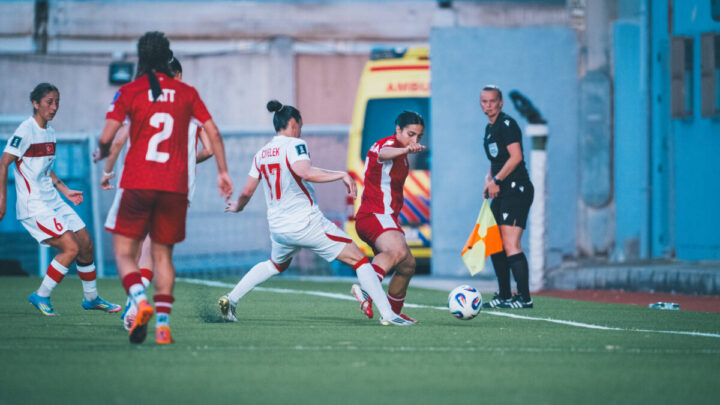
That became one of the clearer details of the night. A slower tempo may have reduced some of the physical strain, but it did not give Malta enough control of the match. Türkiye still pressed second balls, still managed the key spaces, and still left Malta with too few attacking phases to make the rhythm work in their favour.
Maria Farrugia remained Malta’s clearest route forward for long spells, but with Haley Bugeja and Lexine Farrugia unavailable, and with others being asked to carry different roles, the support around the forward line was limited. The problem was not simply that Malta did not attack. It was that those attacks rarely became sustained enough to alter the pattern of the match.
The Plan, The Players And The Risk Of Trying
One of the more interesting details from Tesse’s post-match comments was that Malta’s work to play short from the back did not fully reflect the original plan.
“I’ll be honest we didn’t follow our gameplan,” she said. “Our objective was to build with three at the back, and try to have space for Alexandra to attack. The reality was that we wanted to go long to Kailey to knock it down for Maria to attack the flanks. However, players wanted to play short as they saw the opportunity and it seemed like they felt they could play because Turkey pressed with one. Maybe we were a bit overconfident at times especially between Maya, Tammy and Alexandra, sometimes the ball was a bit short.”
That could have been read only as an issue of execution. Tesse framed it as part of the learning process.
“However, they are young and it’s good for them to try things and if they make mistakes then they can learn. The players who don’t make any mistakes are only those who don’t try anything. So, I’m ok with them trying different approaches in the game, you have to allow players to take that responsibility to develop.”
The answer points toward a freedom in accepting a potentially larger score, with the aim of longer-term gains.
Young Players, Managed Carefully
The final match also brought senior debuts for Nyorah Celeste and Amy Catania, two positives that arrived inside a difficult scoreline and a stretched squad situation.
Questions were fielded around the timing of the introductions, particularly with Malta lacking pace around Maria Farrugia and struggling to alter the rhythm of the match. Tesse explained that the timing was shaped not only by the match situation, but by the condition and age of the players being introduced.
“Nicole & Veronique were put on the pitch at the right time to give energy to the team. Brenda (Borg) couldn’t play against Switzerland because she was sick and today she was trying her best but at the 70th minute she had nothing left in the tank so we substitute her off,” Tesse revealed.
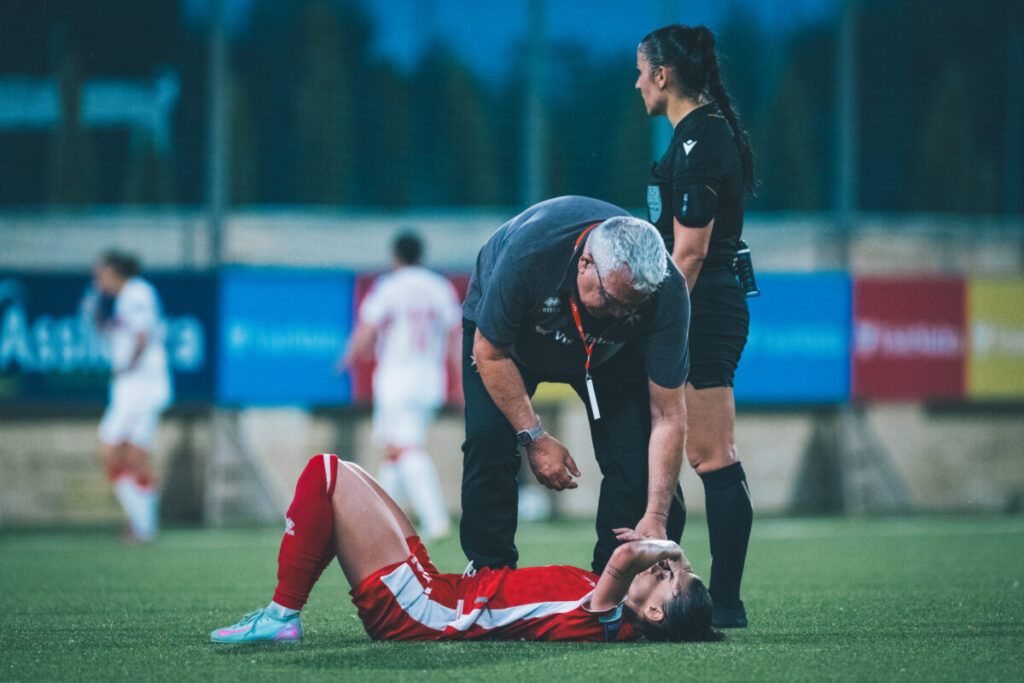
Celeste entered on the 70th minute and offered Malta a different attacking reference. For Tesse, however, the debut had to be managed carefully.
“Nyorah and Francesca (Bartolo) were both doing an exam this morning and in fact Nyorah did not have time to train last week,” Tesse said. “So, putting everything together with a niggle in her quad, I couldn’t put Nyorah in earlier because I wanted to give her the experience but also avoid the player risking injury.”
“As for Amy Catania, I also reasoned that she’s very young, was playing against Saudi Arabia so I wanted to give her the debut but I don’t want to burn the player,” Tesse said. “I think she did well so the future is bright but I don’t want to rush players in, especially a defender. She did very well and demonstrated she can play at this level.”
Lipman also spoke positively about the players coming into the side, while placing that encouragement in the wider context of Malta’s transition.
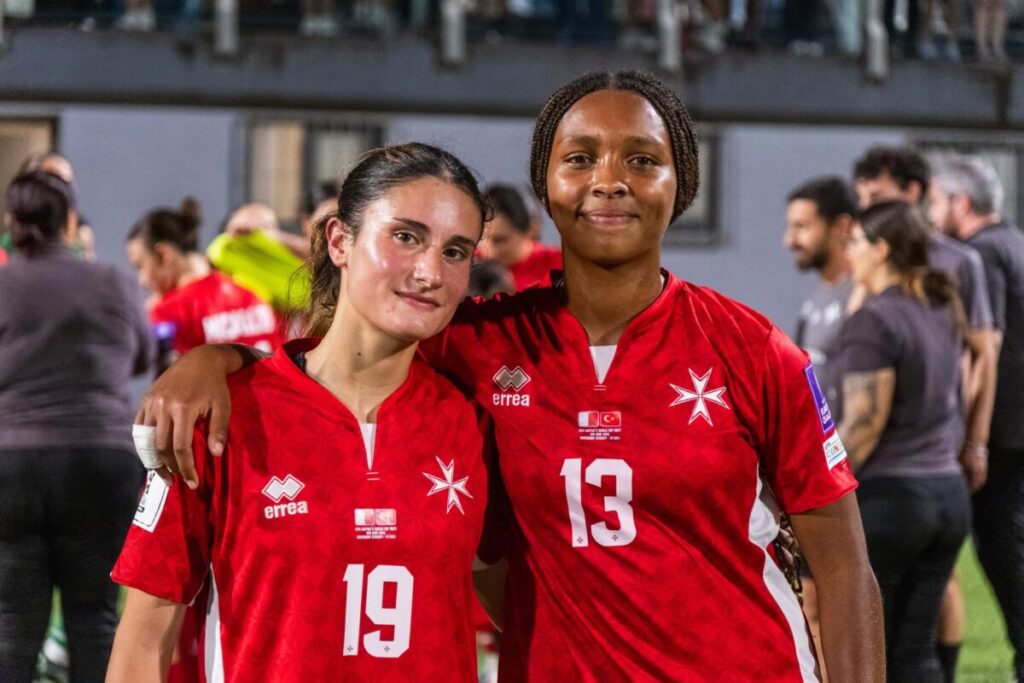
“I think it’s exciting when you consider that Amy isn’t even an U19 player, she’s just fifteen which is crazy in a sense,” Lipman said. “Nyorah also did well to push their full-back. Putting everything in perspective we know we’re in a transitional period and we know we weren’t quite there again.”
The captain’s next point carried the larger meaning.
“However, the future is bright if we believe we can push these girls and give them the experience they need, especially now that we’ll be in League C, then hopefully we can start to build for the future. The aim is to go to League B and stay there. We’ve done it twice and gone down so clearly something’s not quite right, but it’s positive to see these young players coming in and giving great accounts like they did.”
That is a balance Malta must handle carefully. This league B campaign has been positive in the number of inductions of young players into the senior team ranks, however their development needs to become part of a pathway, not only a response to absences.
Positives Beneath A Heavy Campaign
Tesse did not try to dress up the campaign.
“I would say it’s hard to see positives as a coach after losing all games,” she said.
That honesty matters. Malta did not take a point from the group and conceded heavily across the campaign. The final two matches against Switzerland and Türkiye again showed the level of control, physicality and decision-making required to compete consistently in League B.
Still, Tesse pointed to some areas of movement when compared to Malta’s previous appearance at the same level.
“However, I would say in comparison to our last League B appearance we scored more goals, and with respect to League B and also the last League C appearance we have improved our ability to use the bench. I was able to make five substitutions and this means we are giving players experience at this level, that’s a big positive.”
Lipman’s view of the positives was more tactical.
“I would say the biggest positive is that we’ve adapted our style of play,” she said. “In the first League B appearance we were very much playing a low-block and barely countered and when we did we didn’t get a lot of numbers up. This time we attacked with more numbers which is a big plus. I think we need to improve defensively, we conceded way too many goals.”
Ultimately perhaps there was more ambition in the team’s approach than in the previous League B experience. There were more goals. There was greater use of the bench. But the defensive numbers and the final table still carry the weight of a campaign where the step again proved too large.
Physicality, Professionalism And The Balance Still Missing
There were no surprises that clearest part of Tesse’s diagnosis was physical.
“As for things to improve I will reiterate what I’ve been saying but it’s the truth – we need to improve our physicality,” she said. “Switzerland and Turkey have different physicality to Northern Ireland, but all of them are very strong. We lost a lot of second balls and weren’t too strong in tackles so we need to improve. I am aware I am saying this for many years but especially the players playing in Malta need to improve. I know clubs sometimes are scared because the league is important but if they improve their strength, the club will also gain.”
The point has followed Malta through more than one campaign. In League C, Malta’s current tempo and physical base may be enough to compete strongly. In League B, the same margins become harder to hide.
“In League C this tempo is good, but if we want to make the jump and stick in League B we need to make that improvement,” Tesse said. “I am well aware that there are other nations that are in League B like Turkey who don’t want to jump to League A because they know they cannot sustain that next jump. But we need to be clear what we want to achieve and work for it.”
Türkiye’s own progression remained the obvious comparison.
“I want to congratulate Turkey – because like us they got promoted in the first Nations League and they professionalised the league and they have maintained their place and now got second place,” Tesse said.
Her conclusion was direct.
“I think we want to go to League B and sustain it. Maybe next time we will be more experienced and our players will have learned their lessons to be ready, but we need to work for it.”
The question, inevitably, is what that work can realistically look like in an amateur league where many players hold full-time jobs. Tesse did not present the answer as a complete professional overhaul, but as smaller additions that can still change the level of preparation.
“I don’t think 30-40 minutes more in the gym is too much to ask and that is needed if we want to improve,” she said. “We proved this with Brenda Borg in collaboration with Mgarr where with 15 more minutes extra two years ago, she went from eighteen to third in athleticism within the team. This was focused on improving sprint-ability because we know that in League B that ability to go one against one on sprint and also improvement in jumping helps a lot. So, these things can be achieved and it’s not by huge changes. If they want they can achieve this, but it’s up to players.”
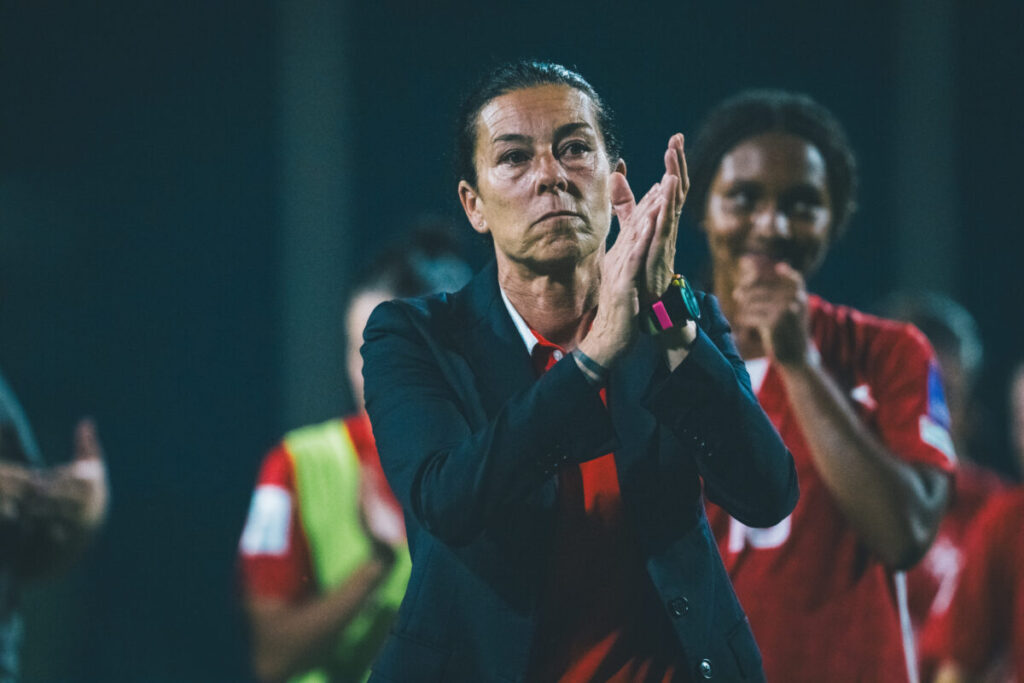
Lipman’s answer moved the same discussion toward professionalism and tactical identity.
“So, I think the trick to stay in League B is to find the balance in being compact and when to push forward as a team, and to embed that in our identity,” she said.
The captain also pointed to the rising level of the women’s game and the need for Malta’s players to move closer to that standard, even within local realities.
“The second biggest thing is professionalism – it’s a big step to go at this level where you will see that the majority of players playing against us are fully professional. We have a lot of Maltese players who are not full-time, but the reality is that the level of women’s football is going up. So, if we want to reach another level then we have to find ways that these players can train and become as professional as they can be. The reality is that we’ve had players like Charlene (Zammit), Steph(ania Farrugia) and Dorianne (Theuma) who pushed hard. They are the best examples proving that it can be done. Now it’s about passing that to the young ones to make that next step.”
Between Tesse and Lipman, the picture becomes clear enough. Malta need more physical readiness, but also more than that. They need the balance to defend without becoming passive, attack without becoming stretched, and prepare like a team trying not only to return to League B but to remain there.
That is the difference between promotion and consolidation. Malta have already managed the first part twice. The next cycle will test whether enough has been learned to make the second part more realistic.
The Türkiye contingent declined to comment following the match.
Lead Image: Brandon Bonett