 by
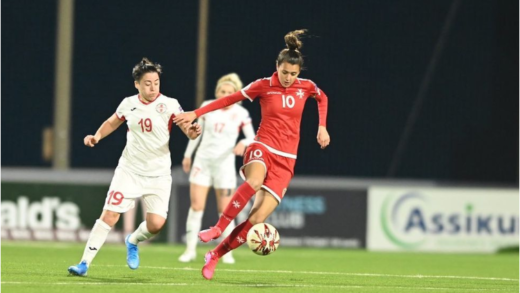
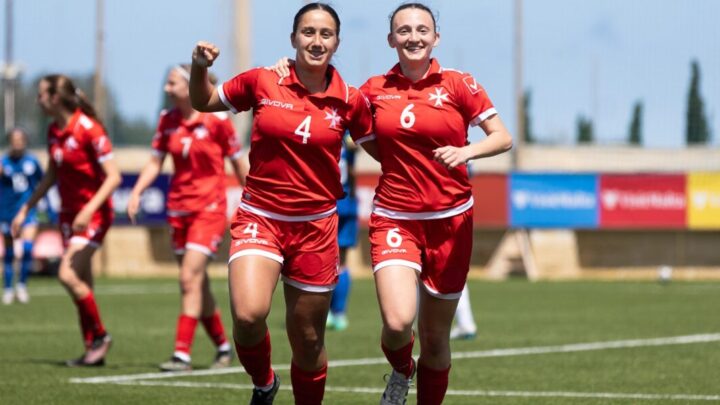
by Malta closed their UEFA Women’s U19 qualification campaign with a 1–0 win over Kazakhstan after heavy defeats to Israel and Bulgaria, with Melania Bajada urging her side to “play without fear rather than just clearing the ball”—a tournament where they showed they are capable of more, even if, as she admitted, “we showed them too much respect at times,” and belief and execution did not always align.
Respect, Not Just Quality, Defined The Early Gap
Malta’s UEFA Women’s U19 European Qualification Round 2 campaign ended with a 1-0 win against Kazakhstan—but not without raising questions on a 7-0 defeat to Israel and 6 – 0 loss to Bulgaria.
Head coach Melania Bajada pointed to a more layered reality behind results — one where performance, belief, and execution did not always align, and the challenge brought about to overturn the impact of opening defeats, into a victory at the end.
“It’s not easy to bring a team together and motivate them in just two days after tough results,” Bajada explained. “During that time, alongside our tactical preparation in training, I focused a lot on building the players’ confidence and attitude.”
That emphasis would become a recurring thread—not as a motivational cliché, but as a structural issue underpinning Malta’s performances.
The opening defeats were not dismissed, but Melania Bajada gave a view of the underlying differences between the two matches, despite both ending in a rather large defeat.
“Israel was a strong side, and I believe we showed them too much respect at times,” Bajada admitted, before drawing a clearer distinction on the Bulgaria match: “Despite another difficult result, our performance improved significantly, and I don’t think the scoreline truly reflected how we played.”
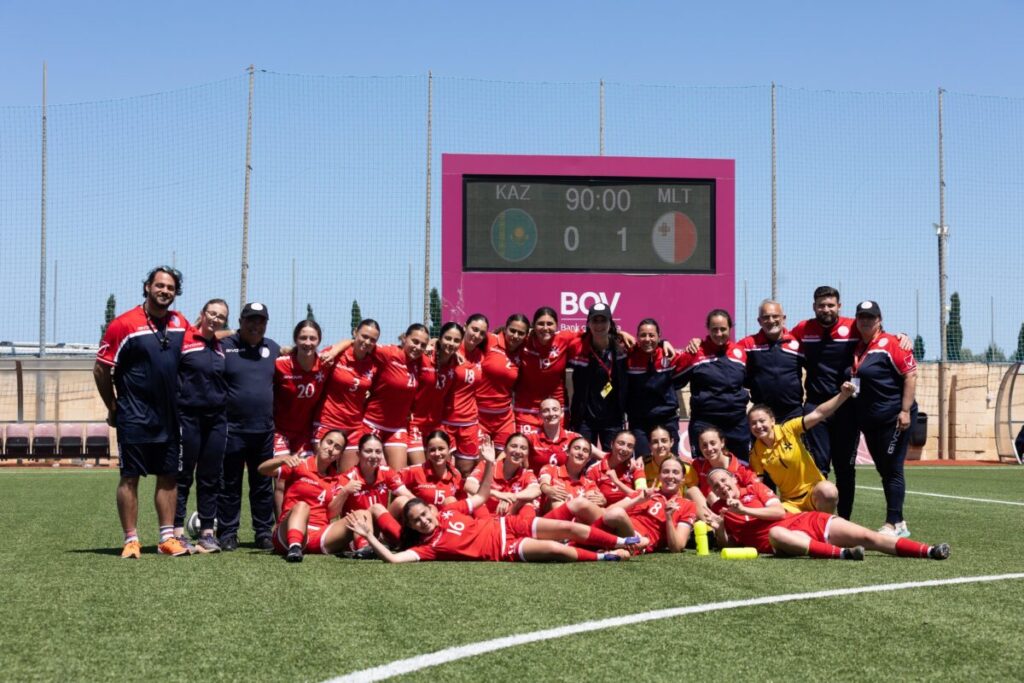
This is where the tournament begins to split into two narratives. On one side: the results, where margins were clear and unforgiving. On the other: phases of play where Malta showed they could compete—until they couldn’t sustain it.
“At this level, even small mistakes can quickly turn into goal-scoring opportunities,” Bajada added.
The implication is not that Malta are being outplayed for 90 minutes—but that their errors carry a higher cost than their good moments carry reward. A narrative that has haunted also Malta’s senior women’s team.
“Belief” As Instruction, Not Slogan
From the touchline, Bajada’s message was consistent: believe. However, the context behind it reveals something deeper.
“Very often, when playing against foreign teams, players feel like they are facing stronger opponents,” she said. “That’s why it’s important that, alongside developing their technical skills, we also instil the belief that we can play football as well.”
The practical impact is visible. A lack of belief doesn’t just affect mindset—it shapes decisions – clearing instead of building, avoiding risk instead of progressing play.
In fact, Bajada underlined the differences observed in training shaped the team talks, “In training, I could clearly see that they are capable of playing good football, so going into the match, I encouraged them to play without fear rather than just clearing the ball.”
Answers that point to the reality of competitive football at its highest form, that it is not ability alone, but whether that ability is trusted under pressure, that dictates outcomes.
Individual Progress, Collective Incompletion
Amid the graft under the Mediterranean sun, there were signs of development. Players like Amber Galea stepped forward in build-up phases, while Thais Muscat showed visible growth compared to previous tournaments.
Bajada herself pointed to a clear pattern, “It was clear that players who were getting regular minutes with their senior teams in the league showed significant progress.”
That is both encouraging and revealing. Encouraging, because the pathway is producing improvement.
Revealing, because that improvement is not evenly distributed across the team and it also raises once more questions surrounding the impact of the 135-minute rule on the rate of development of players at this age group.
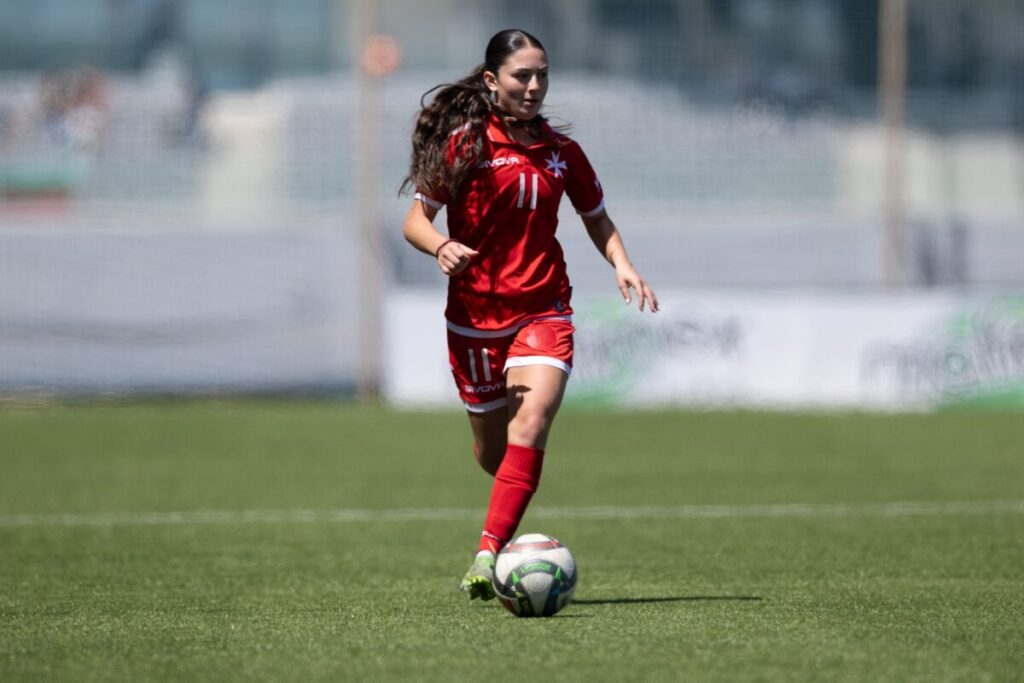
“Experiences like these matches also play an important role in helping them continue to develop,” Bajada noted—but the tournament suggested that development is still happening in pockets, rather than lifting the collective consistently.
An Attack Defined By Absence, Not Lack
Malta’s winning goal against Kazakhstan came through midfielder Ema Micallef—an intervention that could be read as a lack of attacking focal point.
However, Melania Bajada rejected that framing, “I don’t believe that, at this moment we lack forward players in Malta. On the contrary, I see this as one of our strengths.”
Instead, Bajada’s responses point toward the issue as one of availability and continuity, “We had two very promising forwards who were already involved with the senior national team, unfortunately both suffered injuries and I wish Lexine Farrugia and Sara Saliba a speedy recovery.”
The wider picture reinforces her point, “From previous groups we also have players like Maria Farrugia, Kailey Willis, Leah Ayres and Haley Bugeja, who in my opinion are excellent forwards.”
All answers point toward the reality that the talent exists. The challenge is ensuring that it is present, integrated, and connected at the right level, at the right time. Putting into context that Malta has only just in the past few years managed a consistent cohort in each of the U17, U19 and senior competitions, perhaps the management of that pathway gap is a new challenge to face and one brought about by the ambition to improve presence.
The Real Non-Negotiables — Still To Be Built
When asked about the key takeaways, Bajada pointed forward rather than back—highlighting the development of the 2007 cohort and the need to sustain progression into the senior setup.
“Now, we have a couple of 2007 born players who I believe we need to closely follow and continue developing to help them reach the senior team,” hinting at further near-future step-ups. As for the remaining group, “Together with the rest of the group and the players coming through from the U17 level, we will keep working to guide their development and support their improvement both on and off the pitch.”
Her most telling line came in defining what Malta must improve, “We will keep on working on our physicality and mentality as I believe this is something that distinguishes us from other countries.”
Read in context, this is less a statement of identity and more a recognition of the areas to work on. Physicality and mentality are not yet Malta’s defining strengths—they are the areas currently limiting how far the team’s potential can take them.
Malta leave the tournament with a win, evidence of development, and a clearer understanding of where the real work lies.
Until the next time the shirt is worn, players will be hard at work finalising their ends to the 2025/26 season.
Knockout football now takes focus, with the Youth Cup semi-finals this week as Lija-Mgarr face Valletta (tonight), while Swieqi United meet Hibernians tomorrow—both fixtures set for 20:15 at the Centenary Stadium.
The senior competition follows on Sunday at the Victor Tedesco Stadium, where Valletta take on Birkirkara (14:00) before Hibernians meet Mgarr United in the second semi-final (16:30).
Lead Image: Malta FA
Stay up to date by following The Sporting Fan on social media: Instagram ~ Facebook ~ X